
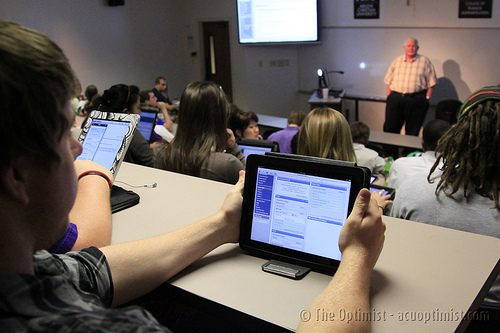
Christiana Kotyk is among the 4,000 undergraduate students at Abilene Christian University who trek across the West Texas campus everyday for classes. Her 10-minute walk to class is weighed down by a backpack stuffed to its breaking point with bulky textbooks – a burden that pains high school and college students across the country.
Kotyk, senior information systems major from Flower Mound, said it’s not a sharp pain but a dull one.
“It gradually intensifies the longer I carry my books around,” Kotyk said.
But the era of bulky books and achy backs may be coming to an end, and some ACU faculty members are testing the alternatives.
Students in Dr. Ian Shepherd’s microeconomics class, including Kotyk, tested the viability of a digital textbook on Apple’s sleek new iPad, a tablet computer that weighs only 25 ounces and measures 9 ½ inches high, 7 ½ inches wide and ¼-inch thick.
Shepherd, associate professor of management sciences at ACU, called his class to order by having his students register attendance on their iPads, integrating the new technology from the beginning of class.
Shepherd said he believes his class is cutting-edge and on the fast track to the future of education.
“I think the iPad is going to revolutionize the publishing industry,” Shepherd said. “It makes economic sense andcommon sense for publishers to move this way.”
Shepherd said he envisions a future where students will be able to have all of their textbooks on the device. He said having textbooks loaded onto the iPad will not only save space and reduce backaches, but also make economic sense, which he said is why microeconomics was the perfect class to pioneer the iPad textbook project in class.
“The beauty of using the iPad is textbooks will be cheaper when you eliminate steps like printing,” Shepherd said. “The story of microeconomics is about two key words, efficiency and productivity. The iPad allows them [publishers] to focus on the intellectual content of the book.”
Shepherd is using the iPad in his microeconomics class again this semester. He said after using the iPad for an entire semester, he believes the device has improved his class and his teaching.
“I think it has made a significant difference in my teaching experience,” Shepherd said. “There is a difference from a traditional class and an iPad class. You now have more comradery, more learning and more movement in the class.”
Shepherd said he hopes the iPad becomes a regular part of his teaching experience.
“My greatest wish is that we can continue the research for the foreseeable future until they become commonplace in the classroom,” Shepherd said.
Kotyk agrees with Shepherd. She said microeconomics was a good class to pilot on the iPad because of the relevancy of the material and the large use of technology required in study.
“I liked that we were able to do class work on it. Economics is a computer, oriented class, and having that shrunk down to the iPad was valuable,” Kotyk said. “The benefit to that is not having to carry computers around. My computer is a 17-inch HP pavilion. It’s a monster.”
George Saltsman, executive director of ACU’s Adams Center, said the university’s commitment to testing the viability of a digital textbook finds its roots in changing the way students learn.
“We believe that textbooks are going digital and will be on a device similar to the iPad in the future,” Saltsman said. “So we are trying to get as much information as we can with the device.”
He said the university has looked at studies saying students learn better when they receive information in a paper format. He said the studies might not mean paper textbooks are preferable, but rather digital formats offer more distractions. Saltsman said the goal is to make digital textbooks a preferable learning tool.
“We are actually testing learning efficacy, looking at the ways students retain information and how that transfers from paper to the iPad,” he said.
Saltsman compared the modern commitment to paper textbooks to one-size-fits-all clothing. In order to meet students’ needs, he said, the way students learn must be ‘customizable.’ The iPad not only provides students with the textbook, but also with access to online resources.
“During the Civil War they had one type of boot, and it was the same for everybody – the same size, no matter the size and shape of your foot. Today we see how people have different footwear for different issues,” Saltsman said. “We are still on that one-boot model. We have one textbook and that’s good for everyone in the class.”
Saltsman said the digital textbook learning experience could operate much like an online bookseller, as opposed to 1800s footwear.
“When I go to Amazon.com, it knows all the things I’ve purchased and what I’m interested in,” Saltsman said. “It provides a custom experience for me every time I visit the site. “We as a university need to focus more on intellectual interests of each individual student.”
Much like Shepherd, Saltsman envisions a classroom where digital textbooks are the future, giving students a wealth of knowledge at their fingertips.
“When the iPod was first introduced it was marketed as ‘1,000 songs in your pocket,’” Saltsman said. “I see the iPad as an entire library in your pocket.”
The iPad or some other mobile device may very well replace the traditional textbook. If it does, it will be welcome news for students like Kotyk and anyone with achy backs.
“We are headed in that direction given how our technology is progressing,” Kotyk said. “I hope it happens, but it’s a tunnel I can’t see the end of.”
