
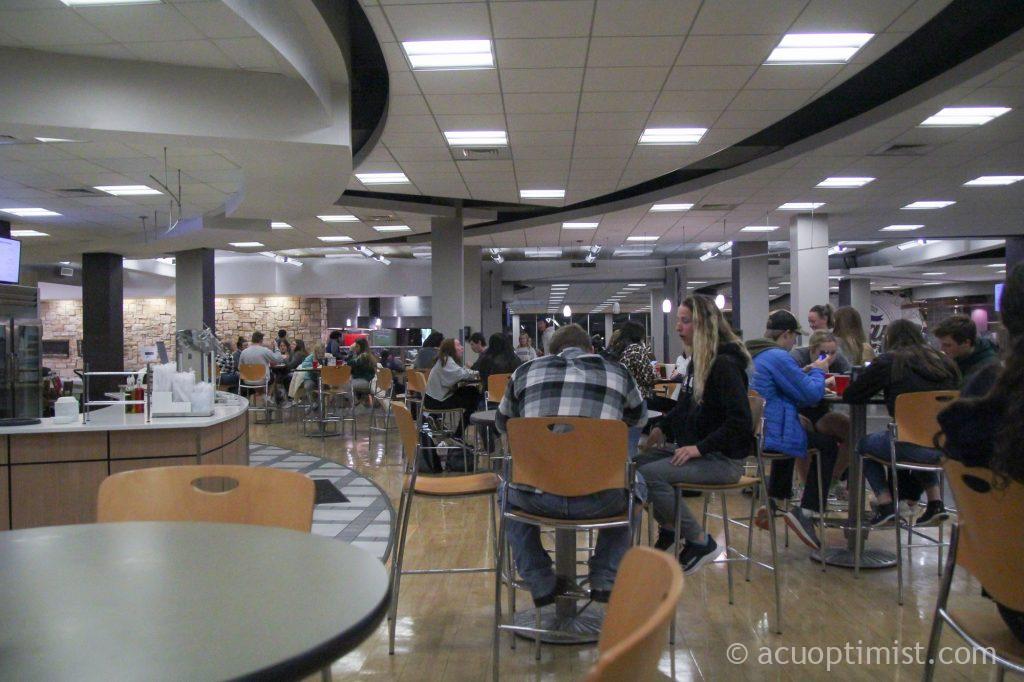
On the purple walls of the World Famous Bean above the bright decals of onions and fresh vegetables appears the word recycling. But when the dishwasher turnstile isn’t running and the trash cans are stacked to the brim during the lunch rush, recycling is the least likely thing on everyone’s minds.
Most students looking at sights in the Bean think about what’s on the menu and not how the menu got there, or how the utensils they use to push around the food on their plate got in their hands. However, the question looms: How does the Bean and the university support sustainability even during trying times?
With many universities, including Harvard and Iowa State University, sustainability is an issue for numerous reasons, including budget constraints, types of dinnerware, and different types of waste removal, according to an audit by Celeste Berg at Williams College.
For David Casida, senior director of ACU dining services, reducing waste and maximizing sustainability is a daily struggle.
“Our mission is to provide high-quality service and try to do it with sustainable ideas in mind as much as possible,” Casida said. “We try to buy products that are treated respectfully and either grown or harvested with those ethics in mind, hoping we aren’t hauling products 10,000 miles away.”
Chartwells Higher Education Dining Services works directly with the Bean and ACU with supplying, budget and other necessary measures. Although some of the produce comes from other states, Chartwells works with about 50 suppliers from the Dallas area that must meet the standards ACU and Chartwells have set in place.
The main goal for the Bean is to reduce its carbon footprint by focusing on sustainability. So far, the efforts in place include the use of reusable metal flatware and white porcelain plates. On top of keeping produce and meats in check, Casida must work with companies to make sure that products, even those as small as napkins, are compostable and safe for the environment.
On the other end of the spectrum, Corey Ruff, associate vice president of operations, is continuously finding new ways to reduce the university’s overall use of energy. Ruff oversees details of facilities, landscaping and the Cenergistic energy conservation program, which requires a full-time energy specialist.
“The biggest impact we have from a daily or weekly perspective is working with the Chartwells staff making sure systems have been turned off when not in use,” Ruff said.
The energy specialist audits buildings and tells building owners which lights have not been turned off.
“We know there is energy waste,” Ruff said. “The utility budget is one of the top 10 expenses in the university budget. So it’s a big deal to conserve as much as possible.”
The McGlothlin Campus Center and the Bean are the largest cost and waste centers because of the work they do, Ruff said.
Casida said they continue to struggle with the amount of waste. At the end of each month, Bean employees weigh the waste and determine consumption percentages to understand how much students are wasting. Casida hopes for the lower number to show up and encourages students to watch how much they put on their plates.
Within other universities, efforts for school farms are implemented to share fresh produce with the cafeteria and students. This can reduce the cost of produce and offset concerns about food waste.
“In some schools, the cafeteria gets fresh produce from the school farm,” Dr. Jim Carpenter, associate professor and chair of the Department of Agricultural and Environmental Sciences, said. “I attended the Christian Scholars Conference at Lipscomb University in June. Instead of disposable plastic silverware, they had wooden bamboo silverware and reusable containers.”
Another key to sustainability is the use of composting and recycling, Carpenter said.
Previously, Ruff and university operations partnered with student organizations like Wildcat Ventures to create a composting program within the Bean, but that program is no longer active.
“We did that for a year or so but it was a student-led program so I believe it ended when the student graduated,” Ruff said.
The process of composting behind the scenes included the breakdown of food from solids to liquids to send to the water treatment plant to be turned back into water. Previously, the Bean and Chartwell employees had tried composting; however, because ACU is landlocked and the environment surrounding Abilene is dry, this has become harder to make a reality.
ACU’s Facilities and Campus Management Department has started the process of composting trimmings from trees, but no action of composting food in the Bean has been taken since the last efforts to do so, Ruff said.
Recently, the rotating dishwasher machine has been down, leading to the inevitable use of paper and styrofoam products.
“It’s expensive when you have to pay for products; nobody likes that.” Ruff said.
The university is in the process of replacing the dishwasher with the goal of a more sustainable machine, Ruff said.
Casida decided the best practices available to him when the dishwasher is down.
“This machine has broken down before. It could be down for a number of weeks, because they don’t have any parts for the machine,” Casida said.
From the audit study, the budget was a big setback for most universities that participated. However, Casida said that isn’t the main issue for the Bean.
“We try not to change our principal ethics based on budgets, although I’m sure that’s a realistic perspective,” Casida said.
While the Bean has many incentives in place already, Casida is still working to promote better ethics and habits. To Casida, education is the best way to encourage sustainability.
“I don’t think we’ll ever stop,” Casida said. “And I think that’s our internal drive as an organization. We want to do the right thing.”
