

ACU fosters a welcoming community for faculty, staff and students – so welcoming that the community extends beyond just the human species.
Wild cats, literally, have claimed their place on campus, and these furry friends are well-known and well-cared for. The Feral Cat Initiative is a student-run organization that monitors these cats.
Recently, a different kind of furry face has appeared at ACU. They are black and have long, narrow faces with distinct white lines running down their backs and all the way to their fluffy tails. These little guys are more than odd-looking cats: they’re skunks.
Skunk sightings on campus are on the rise, and they’re making their increased presence known.
“There certainly has been an uptick in skunks on campus,” said FCI Secretary Ricci Gonzales, senior management major from Bryan. “I actually stopped to let one cross the street 7 minutes ago.”
Even though these new friends have uprooted the campus ecosystem, the cats still reign as the campus sweethearts. The campus cats aren’t to be confused with your typical house cat, though. These felines are feral, and they thrive outside.
Students have picked up on the campus cat territories; many camp out by the Bean, and others hang around between Sherrod and the Library, an area the FCI coined the “canyon.”
The skunks don’t seem to care about the feral cat community’s unspoken territories. Skunks have been spotted near the Feral Cat Feeding Stations posted around campus, munching on cat food.
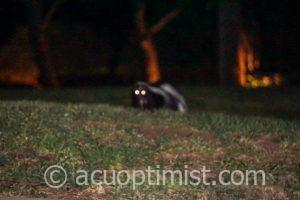
A skunk is spotted on campus at night. (Photo by Callie Leverett)
The skunks are no strangers in campus history. Sightings have been reported over the years; however, many say the numbers have increased.
Philip Nixon, HES Facilities nighttime shift supervisor, said he sees all kinds of wildlife during his shifts. Nixon said many skunks reside by the Hunter Welcome Center.
“There’s a whole family of skunks over there,” Nixon said. “This time of the year, you’re gonna be flooded with deer and stuff, too.”
Skunks are nocturnally active, so late-night and early-morning commuters should keep their eyes peeled – or maybe even nose peeled… as skunks are infamous for their defense mechanism of a terrible-smelling chemical spray.
This notorious, terrible-smelling odor is lingering around campus, and students are noticing.
“I haven’t seen any, but I’ve smelt them,” said Maddie Steffek, junior Kinesiology Pre-AT major from Abilene. “And I know a skunk smell. I live in the country.”
Luckily for those who may encounter a skunk, the odds of a skunk spraying are low, according to the Humane World for Animals. It is a classic case of ‘they are more scared of you than you are of them.’
So, extra discretion at night is advised, but there is also no need to be overly frightened by a skunk sighting.
The Dillard and Barret residence areas seems to be a popular pick among the new up-and-coming skunk community. Kylie Glenn, sophomore psychology major from Amarillo, said she saw a skunk in the alley behind Dillard, and Jacqueline Garcia Torres, senior Marketing major from Abilene, said there’s a skunk that lives under Barret Hall.
“I was doing laundry at like midnight, and then I just see this skunk pass right in front of me,” Garcia Torres said. “I was like, ‘I’m just gonna let him pass, it’s his territory now.’”
