

Twenty-five years after the Sept. 11 terrorist attacks, faculty gathered in the library Thursday to remember where they were, what they saw and how the day changed them.
Eight faculty members shared their memories during the event, organized by Dr. Neal Coates, chair of the Department of Government and Criminal Justice. Coates invited speakers to come forward one at a time and share their stories.
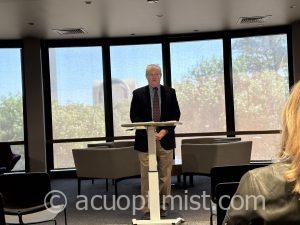
Dr. Neal Coates, chair of the Department of Political Science and Criminal Justice, shares his experience on the day of 9/11. (Photo by Makayla Clayton)
Coates began by remembering his experience as a new professor. He had started teaching in 1999 and was preparing for his 8 a.m. class when he learned a plane had hit the World Trade Center.
He turned on the television in his classroom, where students watched the news as the second plane hit the other tower.
“It’s not the same as if you were there on the ground in person, but it’s still startling, frightening and all those things,” Coates said.
For Mark Lewis, dean of students, the day began as a normal Tuesday. He dropped off his children and wife before driving around campus and praying. While listening to the radio, an announcement interrupted the music with news of the attacks.
When he arrived on campus, people gathered around a television to watch the news.
“As we watched and we listened, no one said a word about what they feared it could be,” Lewis said. “We were hoping it was just a tragic accident.”
Then the second plane hit.
“We were watching the live feed when it happened,” Lewis said. “I didn’t just see what I think I saw.”
Lewis remembers the silence that followed.
“Then there was silence, among student life people, which doesn’t happen often,” he said.
Despite the uncertainty, Lewis had to continue preparing for Chapel. He turned to the Psalms as he tried to decide what to say.
That day, students and faculty gathered in Moody Coliseum for Chapel.
“It was a solemn time of singing hymns,” Lewis said. “We just needed to stick together.”
Lewis said the campus was particularly mindful of students from New York and those with family members in the military, knowing many could soon be deployed.
Four students later came into his office and asked to pray with him. They had a plan to drive all the way to New York because they felt they needed to help in some way. The students traveled to New York City, where they helped at centers with people waiting for information about their loved ones.
“Anyone who interacted with them saw Jesus in those three days,” Lewis said.
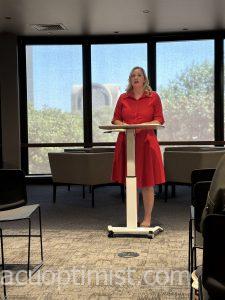
Amanda Biles, assistant professor in the Department of History and Global Studies, shares the story of her waiting in line to give blood on the day of 9/11 at Harding University. (Photo by Makayla Clayton)
Amanda Biles, assistant professor in the Department of History and Global Studies, remembers 9/11 from the perspective of a college freshman at Harding University.
She had gone to breakfast and chapel that morning before classes were canceled. Students gathered in dorms around lobby televisions, where many watched the news and cried.
Biles and her friends decided they wanted to help, so they went to donate blood.
The blood drive was packed, as everyone had the same idea, she said. They waited about five hours to donate.
Later, students gathered in the Bible building to pray.
Biles said she remembers how much campus life changed after the attacks. Some of her friends left school to join the military. American flags appeared around campus, and conversations in classrooms changed.
Susan Lewis, provost and vice president for academic affairs, was a faculty member in the journalism and mass communication department at the time.
She had just dropped her children off at school when she heard the news on the radio. When she arrived on campus, every television in the JMC department was tuned to the coverage.
“There are images that are so haunting even 25 years later,” Lewis said.
She decided not to cancel her class that day. Students did not have to attend, but she wanted them to have a place to be together instead of sitting alone in their dorm rooms.
“A lot of people were unwilling to admit they were afraid,” Lewis said.
Many students stayed after class to watch the news, talk and process what was happening.
For Lewis, one of the most noticeable changes was something that was missing from the sky.
“One of the things about Abilene that you don’t notice until it’s gone is the amount of planes in the air,” she said.
With flights grounded across the country, Abilene became unusually quiet.
“It was notable how quiet it was,” Lewis said.
The next day, Lewis remembers returning to class. Monarch butterflies were migrating, so she and her students took time to watch them and remember God’s goodness.
Donna Seidensticker, executive assistant to the senior vice president of operations, remembered 9/11 from a middle school office. She was working as a secretary when a parent rushed into the office during first period.
The parent told them the United States had been attacked and asked to pick up their son. Seidensticker described the rest of the day as chaotic, with parents arriving to get their children and phones constantly ringing.
“Everyone was afraid and scared of what was going to happen,” Seidensticker said. “They just wanted to be with their families.”
At the end of the day, she said she was grateful to return home and hug her children.
“It was just such a tragic day that is forever embedded in my mind,” she said.

Leave a Comment:
You must be logged in to post a comment.