

ACUPD installed four Flock cameras, automated license plate readers, over the summer at the main intersections surrounding campus.
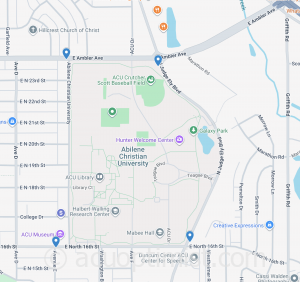
Map shows four Flock cameras surrounding campus. (Screenshot of Apple Maps)
The cameras were manufactured by Flock, are owned by the university and are maintained by the ACU Police Department.
Flock and its competitors have been the center of national controversy, so ACUPD was intentional in the process of adding this new aspect of their surveillance coverage and safety protocols for ACU students and the surrounding community, said ACU Police Chief Jason Ellis.
“No facial recognition, no pictures of the inside of the car — just the outside and the license plate,” Ellis said, describing what separates a license plate reader system from the kind of surveillance students might picture.
The specific camera system that ACUPD purchased does not include a constant live-view feature, which lines up with the department’s intentions behind using the cameras in the first place.
License plate reading cameras were introduced in 1976 and have developed significantly since. Automatic license plate readers track the following:
- License plate numbers
- Vehicle make, model and color
- Distinguishing features, such as decals or damage
- The date, time and location where the vehicle passed a camera
Beyond that, the cameras do capture little additional information.
Lt. Matthew Fox said one of the other driving forces behind the decision was the security of ACU’s NEXT Lab.
“One of the main drivers for getting the Flock camera was the advanced nuclear reactor and criminal trespasses,” Fox said. “We like to know when people who aren’t supposed to be at the university are here, and we felt like it was a necessary thing to have to alert us to any type of terrorist watch list going in and around the nuclear reactor building.”
The four cameras are placed at the four intersections surrounding campus with the goal of covering any vehicle that comes near ACU’s campus — a deliberate choice, Ellis said.
“We picked those locations just because that’s our coming and going from campus, in case we need to identify something or someone,” Ellis said.
While the city of Abilene has placed Flock cameras within city limits, the four cameras near ACU are not owned or operated by the city. According to the ACU Police Department, they are owned, operated and data-controlled by the ACUPD.
“The person who owns the camera, ACUPD, owns the data,” Fox said. “So it’s not third-party listed. It’s not sold to anybody, and we control where that data goes.”
The Abilene Police Department and the Taylor County Sheriff’s Office can request information from ACU police, but they do not have on-demand access.
“They don’t automatically get access,” Fox said.
Every request must come with a case number attached, meaning there is no browsing the system without a stated reason.
“There’s always got to be a reason, case number tied to that search,” Ellis said.
Internally, access is even tighter: Only supervisors and a single detective can run searches at all. “We don’t have random officers running searches,” Fox said.
That structure is by design, not an afterthought, Fox said. Every search, including who ran it, what they searched for and why, is logged permanently, even though the raw camera footage itself isn’t. Plate data is automatically deleted after 30 days. The only data that isn’t deleted is search logs.
“At any time we can do an audit and make sure there’s no misuse,” Ellis said.
That gap is intentional, meaning the department can look back a year later and verify no one used the system outside a legitimate case.
Despite the “surveillance” framing this technology often gets nationally, Ellis said it isn’t built to watch anyone in real time.
“Not live at all,” he said. “They’re retained for 30 days, and that’s it.”
The exception is a “hot list” feature: If a specific plate has been flagged, tied to a criminal trespass order, a stolen vehicle or a registered sex offender, for example, the system sends an automatic alert the moment that plate crosses one of the four cameras. According to ACUPD’s transparency page, everything else sits unreviewed unless an officer goes looking for it as part of an active case.
Ellis said the cameras present a deterrent effect as well.
“The bad guys see that we have Flock cameras. They know not to drive on and off campus, because our number one crime is burglary of a vehicle,” he said.
In the roughly six weeks the cameras had been active as of this interview, ACU police had run three searches total: two tied to hit-and-run investigations and one tied to a missing-child report.
“We’re not running 1,000 searches a day like people are thinking,” Fox said.
License plate readers have also drawn national scrutiny over their potential ties to federal immigration enforcement, a question that has come up locally as well. ACU police confirmed that Flock does not hold contracts with U.S. Immigration and Customs Enforcement and that the company excludes federal agencies from its national and statewide search networks – meaning ICE cannot search the data and does not have access to request data collected by ACU’s cameras.
ACU police will track usage and communicate about the system through a Flock transparency page.
The page will track usage, data and information that students, faculty, parents and the hundreds of community members who use the Lunsford Trail daily might want to know about surveillance around ACU’s campus.
“It is a useful tool for law enforcement as long as it’s not abused,” Ellis said. “We have safeguards in place.”

Leave a Comment:
You must be logged in to post a comment.