

Research by ACT found that the average high school GPA increased from 3.17 in 2010 to 3.36 in 2021. Americans aren’t getting smarter; high school grading is just getting easier. Standardized testing scores, the most objective way of evaluating a student’s academic standing, have remained the same or have fallen, while GPAs are increasing.
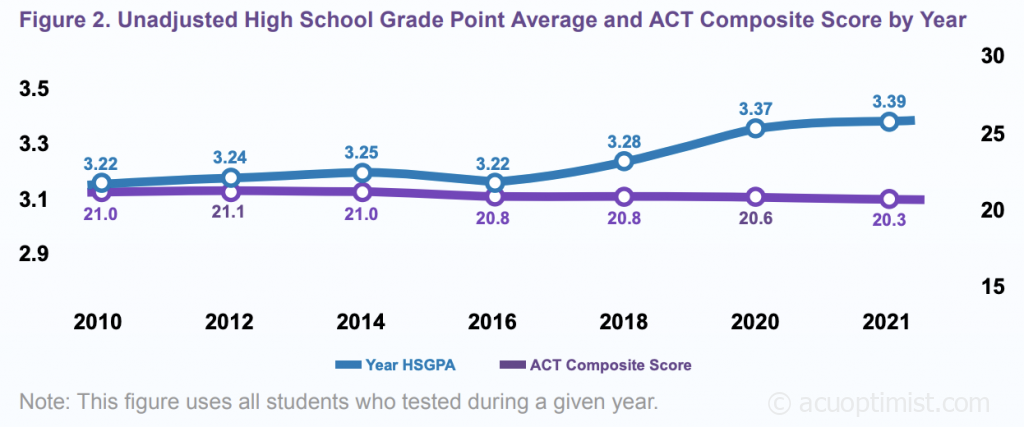
Graph from ACT research report “Grade Inflation Continues to Grow in the Past Decade”
Grade inflation is the trend of students receiving higher grades for work that historically would not be considered good quality. Grade inflation sends graduates to college with unrealistic expectations of how much effort will be needed to succeed in college courses.
Dr. Traci Yandell taught in public school for 29 years and has taught basic math and math education courses at ACU for nine years. Yandell recalls that grade inflation became most prevalent when the no-pass, no-play rule in UIL was implemented in public schools. Teachers were pressured to let their students pass so that they could participate in band, athletics, etc. She said there was a time when some districts wouldn’t allow teachers to score lower than a 50 on any assignment, even if the student didn’t turn in any work.
“When they get into college, I find especially with my freshmen that they think it keeps going that way,” said Yandell. “When I sit and say no, that quiz is closed or no, that assignment was due, I can’t open it back up, it’s hard for them to understand why.”
Yandell and the Office of the Provost fight against the effects of high school grade inflation by supporting students as they adjust to the workload of college academics while still honoring ACU’s standards of academic excellence.
Yandell said she is all about keeping the integrity of a course. She realizes that passing everyone could make a class look too easy, and failing too many could reflect poorly on her approach to teaching the material. She doesn’t pass or fail students for the optics. Yandell said she’d be happy if everyone passed, but the reality is that some students do fail.
Although Yandell won’t allow students to redo countless assignments like they may have been able to in high school, she said she drops assignments and gives curves because she realizes that the few points between a C and a B, or a B and an A, could be on her teaching.
Dr. Laura Carroll, Assistant Provost for Teaching, Learning and Vocational Formation, said the Provost looks out for classes that have high amounts of students who drop, fail, or withdraw.
“Ultimately, the department is going to know what’s best for their curriculum, and so they would design something to meet those students’ needs,” Carroll said. “So the provost just encourages them to make the changes, and supports them through those changes.”
At most universities, grade inflation makes college admissions more challenging. Accurate grades are needed to tell the whole story of a student’s academic success. Garrett Sublette, Dean of Admissions, said ACU’s admissions department has their own grading scale that puts every applicant on the same playing field when it comes to determining admittance and scholarship amount. They don’t take into account a student’s entire transcript, just their five core classes. Those grades are imputed into a system that then calculates a student’s GPA based on ACU’s scale.
Sublette said around 10 years ago, admissions switched from just looking at a student’s test scores to looking holistically at a student’s GPA, class rank, and test scores. Even though grade inflation has an impact on students’ GPAs, test scores don’t accurately tell the full story of a student’s academic performance either. Some students are very smart and capable, just bad test takers.
Sublette said, “We really saw that all three things were important. And that if a student maintained success over a period of time in high school, that was actually more predictive of their success in the future than a one-day test score.”
To solve the issue of grade inflation in high school, Yandell said teachers should be stricter on due dates and give students fewer opportunities to redo tests and assignments so that they put more effort into preparing initially and are prepared for the structure of college classes. At the college level, Yandell stressed the importance of students coming in outside of class to get help from their professors in person. Extra effort, relationship with professors, and mentorship go a long way in bridging the gap between high school and college.

Many school districts still forbid grades lower than a 50, with unlimited chances at a “redo.” Students are graduating high school with no concept of consequences for bad academic behavior. It’s quite sad.